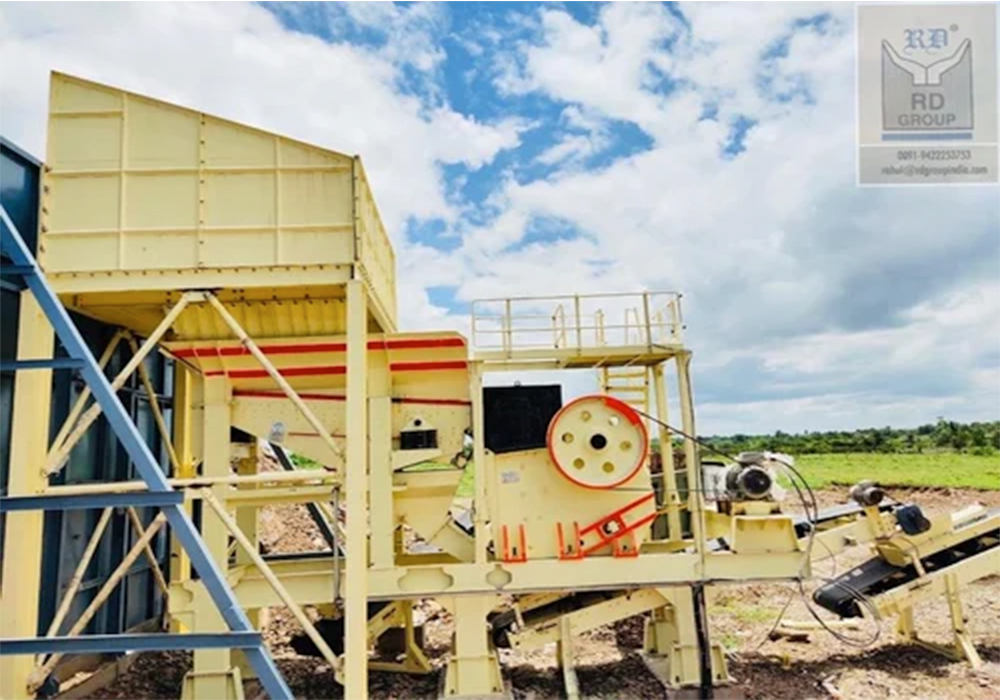





RD Group is one of the top manufacturers‚ suppliers and exporters of high-performance Jaw Crusher Machines in Nashik‚ India‚ delivering high productivity and profitability through powerful machines․
Jaw Crusher Machine is one of the most reliable and efficient machines used for primary size reduction in the mining and construction industries․ This machine is capable of handling tough materials with ease․ It is used to break down large‚ hard rocks to a smaller size so they can be processed․
While working in both mining and construction industries‚ a jaw crusher will usually produce the highest productivity‚ output and efficiency․ It is a strong‚ heavy duty machine with a long service life that can be used for various industrial applications․
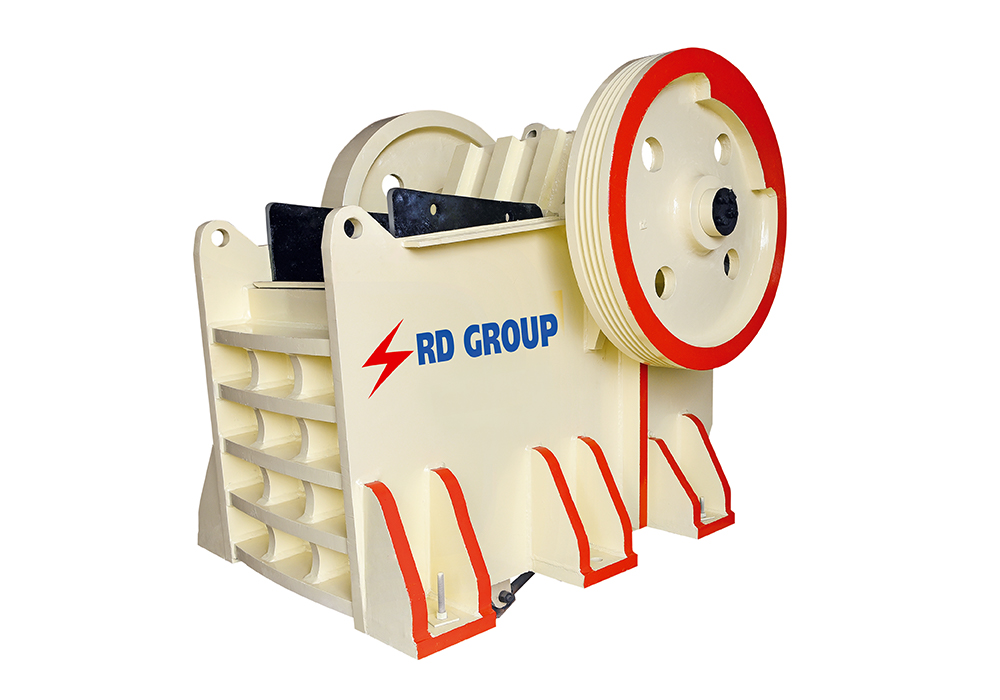
RD Group's jaw crushers are engineered to provide top performance and durability, designed to handle the evolving needs of various industries while consistently producing high-quality results across a spectrum of applications.
RD Jaw Crushers are optimized to process all feed materials and produce desired end products with maximum efficiency and reliability and minimum economic loss through innovative technology.
RD Jaw Crushers are equipped with innovative technology to ensure maximum productivity and performance while keeping operational costs to a minimum.
RD Jaw Crushers are designed for maximum performance and flexibility with a powerful single-toggle mechanism, wide range of interchangeable jaw plates and hydraulically adjusted Closed Side Setting (CSS). The optimized nip angle, coupled with a wide range of feed openings, provides efficient material intake and consistent crushing output. Each model is created to be versatile, easy to use, and extremely productive, satisfying the rigorous demand of modern crushing operations.
RD Jaw Crushers are highly versatile and can be used in various applications. Using the right configuration of crushers can make it easy to adjust to varying production demands. These crushers are well suited for the crushing of a wide range of hard and abrasive materials such as gabbro, basalt, granite, sandstone and quartz. Due to their small size and simplicity of maintenance, they are a great option for stationary installations or mobile ones.
RD Jaw Crushers are the best solution for high capacity, superior power and large feed openings where these requirements are required for aggregate and mining applications. They are designed to be efficient and reliable so that the process can be optimized easily and the whole crushing process can be fully automated. RD Jaw Crushers give you power, flexibility and control to maximize productivity and profitability.
| Technical Specification JAW CRUSHER | ||||||||||||||||
|---|---|---|---|---|---|---|---|---|---|---|---|---|---|---|---|---|
| MODELS | FEED OPENING (L x W) (mm) | MAX. FEED SIZE (mm) | MOTOR (hp/kW) | RPM | WEIGHT (TON) | AVERAGE CAPACITY (Tons/hr.) AS PER CSS RANGE (mm) | ||||||||||
| 25 | 38 | 50 | 63 | 75 | 90 | 100 | 125 | 150 | 175 | 200 | ||||||
| RDJC 2412 | 610 x 305 | 250 | 50 / 37 | 310 | 6 | 28 | 33 | 43 | 48 | 55 | 62 | |||||
| RDJC 2415 | 610 x 381 | 300 | 50 / 37 | 310 | 6.6 | 40 | 45 | 53 | 60 | 70 | ||||||
| RDJC 3015 | 762 x 381 | 300 | 50 / 37 | 285 | 7.4 | 50 | 63 | 70 | 80 | 88 | ||||||
| RDJC 3024 | 762 x 508 | 400 | 60 / 45 | 285 | 10 | 68 | 72 | 80 | 98 | |||||||
| RDJC 3624 | 914 x 610 | 500 | 75 / 55 | 280 | 16.6 | 80 | 90 | 125 | 140 | 175 | 200 | |||||
| RDJC 3628 | 914 x 710 | 600 | 100 / 75 | 280 | 17.2 | 115 | 140 | 165 | 190 | 215 | 240 | |||||
| RDJC 4232 | 1067 x 813 | 650 | 150 / 110 | 265 | 21.4 | 125 | 150 | 175 | 200 | 250 | 275 | |||||
| RDJC 4432 | 1118 x 813 | 650 | 150 / 110 | 280 | 22.5 | 165 | 190 | 230 | 280 | 330 | ||||||
| RDJC 4236 | 1067 x 914 | 750 | 180 / 132 | 260 | 24 | 175 | 200 | 250 | 300 | 350 | ||||||
| RDJC 4436 | 1118 x 914 | 750 | 180 / 132 | 260 | 24.6 | 200 | 225 | 275 | 330 | 375 | ||||||
| RDJC 5040 | 1270 x 1016 | 915 | 215 / 160 | 260 | 35 | 300 | 340 | 375 | 455 | |||||||
A jaw crusher is a heavy duty machine that works to crush large rocks, ores among other materials into smaller sizes so that some operations can be done on them. Its operating principle is a crushing chamber in the sense that material is squeezed between fixed and moving jaw. As the swing jaw draws near the fixed jaw material is size reduced until when it is reduced to a size that fits through the bottom opening. The jaw crushers have this simple but powerful mechanism which enables the industry to use these jaw crushers in mining, construction, demolition, and recycling industries.
Optimised Crushing Excellence
RD Jaw Crushers are precision-engineered to deliver maximum efficiency by perfectly balancing four critical performance factors:
These are the major parameters that complement each other to provide accurate production, lower downtime, and better operational efficiency.
The deep, symmetrical crushing chamber is specifically designed to:
This results in higher productivity while maintaining uniform product quality.
An optimised nip angle ensures smooth and continuous material flow through the crushing chamber, delivering:s
By reducing wear and improving crushing efficiency, RD Jaw Crushers help you achieve:
RD Jaw Crushers – Powering Performance. Maximising Productivity.
RD Jaw Crushers are versatile, multi-industry machines designed to perform efficiently across a wide range of crushing applications.
RD Jaw Crushers are designed for heavy duty operations and are suitable for crushing hard and abrasive materials like:
Ensuring reliable performance in demanding mining environments.
Essential for producing high-quality construction materials, including:
Supporting infrastructure development with consistent and durable output.
Efficiently process and reduce construction waste materials such as:
Enabling sustainable reuse and reducing environmental impact.
Suitable for small to medium-scale material processing in manufacturing industries, including:
Delivering precise size reduction for various industrial applications.
RD Jaw Crushers – Versatility That Powers Every Industry.
R D Group jaw crushers have a rugged construction and high-quality wear parts, which prolong the lifetime of these machines to decades through maintenance.
Hard rocks and ores to the softer construction materials such as limestone, and also recycled concrete and asphalt, and industrial minerals.
Jaw crushers can do the first-pass breakage (primary crushing) and are the best breakers, in terms of throughput, cost to operate, and ease of maintenance, as compared to starting with impacts or cone breaks.