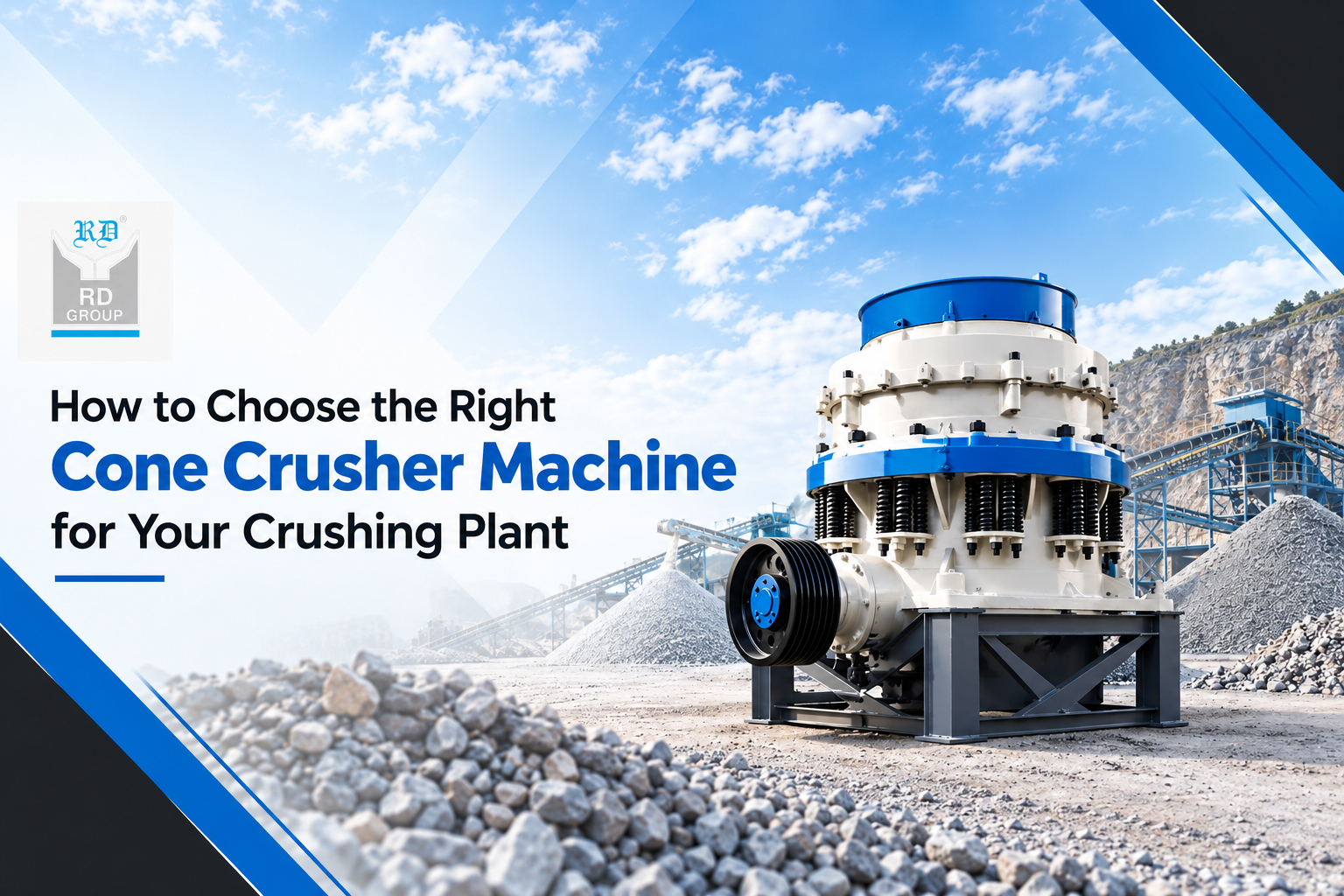
How to Choose the Right Cone Crusher Machine for Your Crushing Plant
Choosing the right cone crusher machine is an
important decision in the process of setting up or upgrading a crushing plant. The crusher should be able
to crush the desired feed material to the desired product size and at the required rate of
production, and should do so without excessive wear or downtime.
The cone crusher is mainly used for secondary and tertiary crushing, and it is suitable for
crushing hard and abrasive materials like granite, basalt, limestone, aggregates, and other
kinds of ore. But it does not just depend on the motor power or capacity.
The selection of the proper type depends on various aspects such as feed size, hardness of
the material, capacity, output size, crushing stage, crushing chamber, closed-side setting
(CSS) and the configuration of the crushing circuit as a whole.
Why Is Proper Cone Crusher Selection Important?
Selecting an incorrectly sized or configured crusher can affect the performance of the entire
crushing plant.
If the crushing plant is too small, it will be difficult to get the production requirements,
and if too large, it will bring a lot of initial investment and operation costs, it has
nothing to do with the practical effect.
The selected cone crusher should thus be designed to meet the needs of the entire plant and
not just the maximum advertised capacity.
Important considerations include:
- Required production capacity in TPH
- Maximum feed size
- Feed material characteristics
- Required product size
- Crushing stage
- Crushing chamber
- Closed-side setting (CSS)
- Screen and conveyor capacity
- Expected operating hours
- Wear and maintenance requirements
1. Understand the Feed Material
It is essential to know the material to be sorted through the cone crusher when deciding its
model.
There are various degrees of hardness, abrasiveness, moisture content and crushability among
different rocks and ores. These properties are directly related to the performance of the
crusher, wear characteristics, power consumption, and production rates.
Cone crushers can process a variety of materials such as:
- Granite
- Basalt
- Limestone
- River stone
- Quartzite
- Iron ore
- Other hard and abrasive minerals
For hard and abrasive materials, the crusher and its wear components must be suitable for
continuous crushing conditions.
The feed should also be properly graded. Oversized material can reduce capacity and increase
abnormal wear, while excessive fines can contribute to packing and unstable operation in
some crushing chambers.
2. Check the Maximum Feed Size
Feed size is one of the most important factors when choosing a cone crusher.
Before selecting a model, determine the maximum size of material entering the cone crusher
after primary crushing.
For example, if a jaw crusher produces material with a
relatively large top size, the selected cone crusher needs a chamber and feed opening
capable of accepting that material.
A crusher should not be selected only according to its TPH rating. The feed opening and
selected crushing chamber must also accommodate the actual feed size.
Key questions to ask:
- What is the maximum feed size?
- What is the average feed size?
- What is the feed size distribution?
- Is the material coming directly from a jaw crusher?
- Is excessive fine material present in the feed?
Matching the feed size with the appropriate chamber helps maintain stable operation and
reduces unnecessary wear.
3. Determine the Required Production Capacity
Capacity is another major consideration when selecting a cone crusher.
Production requirements are generally expressed in tons per hour (TPH). But the actual
production capacity of the cone crusher is not only determined by the nominal capacity of
the model.
Throughput can be affected by various factors including CSS, chamber type, feed size,
material properties, and plant configuration.
Therefore, instead of selecting a machine simply because its maximum capacity appears
suitable, consider the expected operating capacity under your actual working conditions.
For example, if your plant requires 250 TPH of continuous production, the selected crusher
should have sufficient capacity under the required feed and product conditions, preferably
with a practical operating margin.
The crusher should also be properly matched with:
- Jaw crusher capacity
- Vibrating screen capacity
- Conveyor capacity
- Feeders
- Recirculating load in closed-circuit plants
The complete crushing plant can only achieve its desired output when the major equipment
works together at compatible capacities.
4. Select the Correct Crushing Stage
Cone crushers can be used at different stages of a crushing circuit.
Secondary Crushing:
Secondary crushing is the stage where the material is fed into the cone crusher from the
primary crusher stage and it is further crushed for screening or further crushing.
A suitable secondary cone crusher generally needs to accommodate relatively larger feed
material while producing the required intermediate product size.
Tertiary Crushing:
Tertiary crushing focuses on producing a finer and more controlled product.
The feed entering the cone is generally smaller, allowing a suitable finer chamber and
tighter CSS to be used depending on the required final product.
The choice between secondary and tertiary applications should therefore be
considered before selecting the crusher model and chamber.
5. Choose the Right Crushing Chamber
The crushing chamber is one of the most important aspects of cone crusher selection.
Different chamber profiles are designed for different combinations of feed size, product
size, and crushing duty.
Generally, coarser chambers can accept larger feed material, while finer chambers are better
suited to producing smaller products when the feed is appropriately sized.
The chamber should be selected according to:
- Maximum feed size
- Desired product size
- Required reduction
- Crushing stage
- Material characteristics
- Required production rate
Choosing an unsuitable chamber can limit the performance of an otherwise correctly sized
crusher.
6. Understand Closed-Side Setting (CSS)
Closed-Side Setting (CSS) is the minimum distance between the mantle and concave during the
crushing cycle.
CSS has a direct effect on product size and also influences capacity and power consumption.
In general:
- Smaller CSS: finer product
- Larger CSS: coarser product and potentially higher throughput
If the run is carried out continuously at an inappropriate setting, it can impact capacity,
power consumption, product gradation and wear.
When selecting a cone crusher, you should first find out what the desired product size is,
and then make sure that the selected machine and chamber can get to the desired product size
in stable operation.
7. Consider the Required Product Size
The final product specification should be established before selecting the crusher.
For example, an aggregate plant may require specific sizes such as:
- 40 mm aggregate
- 20 mm aggregate
- 10 mm aggregate
- Manufactured sand feed
- Specific graded aggregate fractions
The selection of the cone crusher should be based on the output distribution, not only on the
smallest output product.
If the required product is very fine, the plant may need a suitable chamber, tighter CSS,
additional screening, or another crushing stage.
The crusher, screen, and recirculation system should therefore be designed as one integrated
process.
8. Consider Material Hardness and Abrasiveness
Hard and abrasive materials can significantly influence wear-part consumption.
Materials such as granite, basalt, quartzite, and certain ores can place greater demands on
the mantle and concave.
When selecting a cone crusher for such applications, consider:
- Material hardness
- Abrasiveness
- Feed size
- Required reduction
- Expected operating hours
- Wear-part availability
- Maintenance requirements
The proper configuration of the crusher can assist in controlling wear and operating costs
and maintain consistent production.
9. Select the Proper Cone Crusher for the Screening System
The cone crushing machine cannot operate independently.
In modern crushing plant it is used in conjunction with feeders, conveyors, vibrating screens, and sometimes additional crushing
equipment.
The screen separates the material into a final product and material to be returned to the
crusher in a closed circuit.
When the crusher generates more material than the screen can handle, the screen can be a
bottleneck. In the same way, if the capacity of the crusher is insufficient, the plant will
not have the required production. Therefore, the capacity of the crusher and screening
system should be considered together.
10. Consider Choke Feeding and Feed Distribution
A steady feed is important to a cone's steady operation.
It is advisable to ensure a uniform and consistent feed of material into the crushing chamber
of a cone crusher. Feed unevenly or in insufficient amounts to lower production and even
cause wear to be uneven.
A properly managed feed can help:
- Maintain stable production
- Improve product consistency
- Distribute wear more evenly
- Improve crushing efficiency
- Reduce unnecessary operating fluctuations
Feed distribution is therefore an important consideration when designing the complete
crushing circuit.
11. Evaluate Maintenance and Wear-Part Requirements
Initial purchase price should not be the only factor considered when selecting a cone
crusher.
The long-term cost of ownership can be affected by:
- Mantle and concave replacement
- Lubrication requirements
- Hydraulic components
- Spare parts availability
- Maintenance accessibility
- Downtime
- Service support
A crushing plant that is always in operation can be significantly affected by the
availability and reliability of after-sales support and timely replacement of wear parts.
12. Select Cone Crusher Manufacturer That Has Technical Support
Choosing the appropriate machine is just one aspect of the process. Manufacturer or supplier
also has to be able to understand the application and suggest an appropriate configuration.
Before purchasing, discuss the following information with the manufacturer:
- Material type
- Maximum feed size
- Feed gradation
- Required TPH
- Desired product size
- Crushing stage
- Operating hours
- Plant layout
- Screening arrangement
- Expected material characteristics
This information allows the crusher to be selected according to the actual application rather
than simply choosing a model based on its nameplate capacity.
Frequently Asked Questions (FAQ)
Start by evaluating the material type, maximum feed size, required TPH,
desired product size, crushing stage, chamber type, and CSS. The selected
model should meet these requirements under actual operating conditions.
There is no single factor that determines the correct crusher. Feed size,
material characteristics, capacity, product size, chamber selection, and CSS
all need to be considered together.
CSS affects product size, capacity, and power draw. The tighter the setting,
the finer the product, and the wider the setting, the coarser the product
and the greater the potential throughput.
Yes. The cone crusher is available in secondary or tertiary series according
to the feed size, crushing chamber, CSS, and product size.
The chamber determines the type and size of feed that can be processed and
influences the achievable product size and crushing performance. The chamber
should be selected according to the feed and required product rather than
chosen independently.
No. This will depend on the hardness of the material, the feed
characteristics, the chamber type, the CSS, moisture, fines and the overall
crushing circuit.